
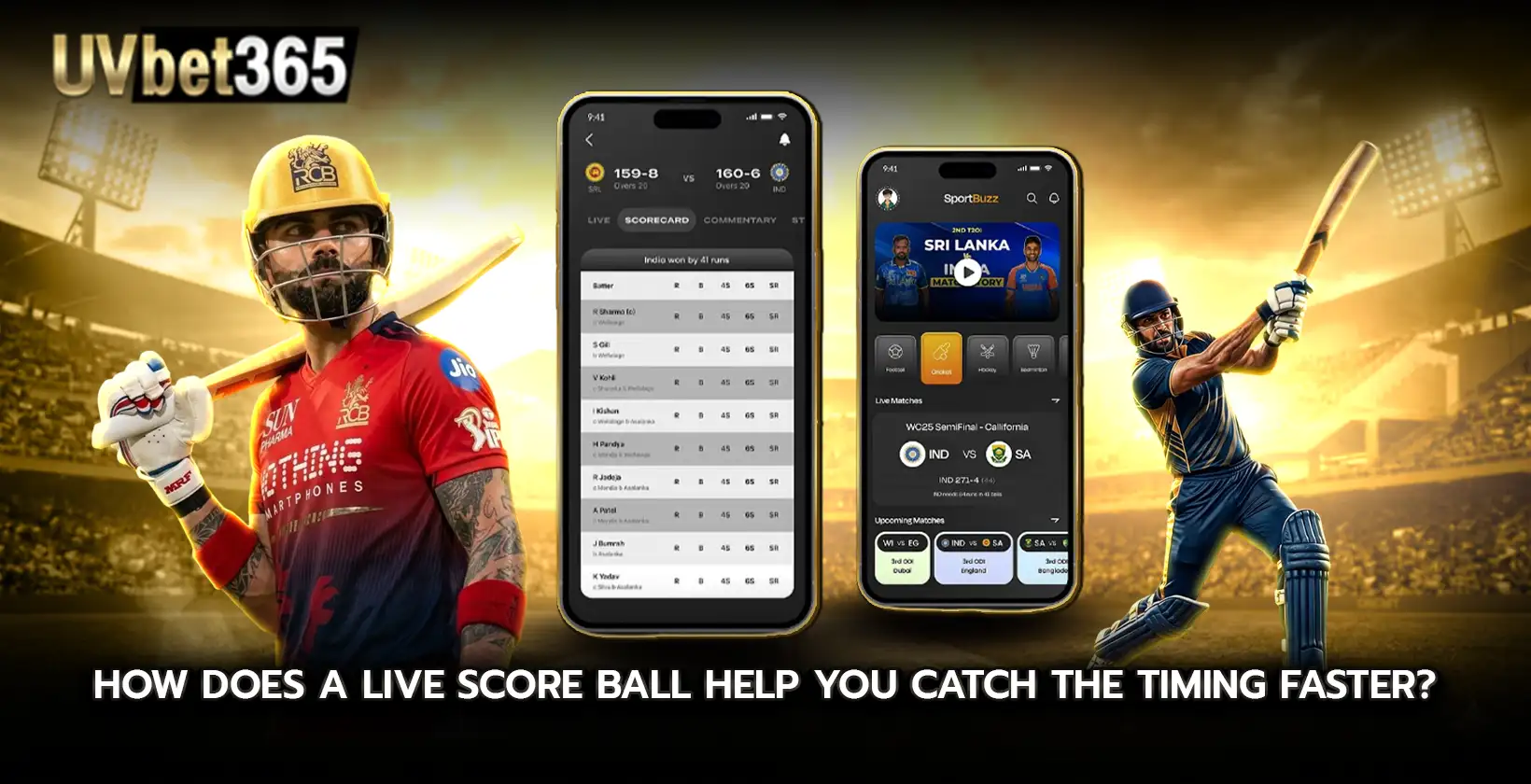
A Live Score Ball helps you make decisions faster than watching total points alone, because it shows the match evolving one moment at a time. It highlights pressure from the bowling unit, the shape of an over that is about to end, and the window when the market may shift before it locks.
This is especially important during Cricket Live, when users who can read ball-by-ball information quickly often gain more decision time than those who wait for the overall score.
For practical use, the key is not looking at as many numbers as possible, but identifying which moment is changing and whether that moment is already useful for a Live Bill. If the reading is fast enough, a player does not need to wait until the price fully reflects the situation before reacting.
Why live score ball Helps You See the match tempo Faster Than Watching current score

The total score shows what has already happened, while ball-by-ball information reveals whether the game is about to change.
People who rely only on the total score often react after the shift has already occurred, while those reading the Cricket Scorecard alongside Live Score Ball can detect early signals such as building pressure or declining momentum.
Total Points Shows the Destination, but Ball-by-Ball Information Shows the Turning Points Along the Way
Looking only at the totals shows which team is ahead, but not how the game is evolving. Ball by ball data reveals whether the batting lineup is slowing down, whether the bowling unit is applying pressure, and whether the price is likely to react.
People Who See One Moment Earlier Usually Have More Time to Decide
The advantage of reading information does not come from knowing more in a broad sense. It comes from knowing slightly earlier. If a player notices the turning point before the price fully reacts, that player will have more time to assess the situation than someone who waits until the price has already changed clearly and only then follows. People who watch only Live Cricket Score may see only the overall number, but those who follow ball-by-ball information can spot the shift in the match much faster.
How Does Live Score Ball Help Track the Bowler’s Momentum?

One reason ball by ball information is so valuable is that it helps reveal the bowler’s momentum faster than watching only the total score. Pressure from the bowling side is not reflected only through fewer runs, but through the delivery sequence, pace control, and how the batting lineup is forced into uncomfortable situations. These are key signals for decision timing before the price fully reacts.
What Kind of Delivery Pattern Shows That the Bowling Side Is Taking Control?
If Live Data shows that the batting side is finding it harder to rotate the strike, is playing more cautiously, or that the rhythm of the game is slowing down continuously, it usually reflects that the bowling side is taking control. Even if the total score has not changed significantly, pressure may already be building.
When Momentum Changes, the Market Often Has a Chance to Move with It
When the Bowler truly begins to gain the upper hand, the market is often ready to respond shortly after, because the information already shows that the shape of the game has changed. If you wait until everything becomes obvious, the timing advantage usually disappears.
A Quick Way to Tell Whether the Bowling Side Is Gaining Control or Losing Rhythm
Look at whether scoring remains consistent, whether the game is flowing smoothly or becoming difficult, and whether delivery patterns are changing. If tension builds across several deliveries, it usually signals that the bowling side holds momentum.
In practical use, if pressure continues for 3–4 deliveries in a row, it can signal a moment to act, as the market may shift soon. However, if momentum continues to swing back and forth, it is better to wait until the overall pattern becomes clearer.
How Does Next Over Help Anticipate the Moment Before the Market Changes?
Looking ahead to the Next Over allows a player to think proactively rather than reactively. The period before an over ends often provides enough information to assess whether the game will continue in the same pattern or shift in the next phase.
Why Is the Period Before the End of an Over a Point Where the Market Changes Quickly?
When the match is close to completing one full Over, the information gathered during that sequence begins to show more clearly which side is gaining the advantage. This is why the market often reacts quickly at this stage, as the overall picture of the over becomes more complete and easier to interpret.
If the Shape of the Over Is Becoming Clear, How Is Looking at the Next Over Useful?
If it is already clear that the current over is putting pressure on the batting side, or that the batting side is starting to lose its rhythm, then looking ahead to the next over helps the player avoid waiting for the market to move first. Instead, they can begin assessing in advance which direction the next phase is likely to take.
How to Use Consecutive Ball Information to Predict the Direction of the Next Phase
Observe whether the pressure in the current over is easing or continuing to build. If the pressure is consistently applied, the next phase is likely to remain tense. If the batting side begins to recover, the match rhythm may shift quickly.
In practical use, if the current over continues to control the batting side and the game structure remains unchanged, the next over is likely to follow the same pattern, allowing earlier action before the market moves. However, if the pattern weakens or pressure is released, it is better to wait rather than assume continuation. This helps support faster and more accurate decision-making.
What Should You Watch from a Live Score Ball Before the Slip Gets Locked?
The period before a slip is locked requires quick decisions, but speed alone is not enough. What matters is identifying the right signals on the screen to distinguish between ‘act now” and “wait”.
Ball by ball data is important here because it reveals game changes before the market fully responds.
The Right Moment to Decide Often Comes Before the Market Fully Reflects It
In many situations, the market does not adjust immediately when the Cricket Game begins to shift. Users who read ball-by-ball information quickly gain a short but valuable window to decide whether to act or observe further.
What Signs Suggest the Price Will Change Soon or the Slip Will Be Locked?
If the Cricket flow changes rapidly, pressure builds continuously, or the over is nearing completion, the market often reacts shortly after.
4 quick signs to check:
- Continuous pressure in the match
- Clear momentum from one side
- Over nearing completion
- Price not fully adjusted
If multiple signals appear together, action may be justified. If only one signal appears or the situation is unclear. Waiting is the better option.
How Can You Be Fast Enough Without Rushing So Much That You Break Your Plan?
The safest method is to define clear signals in advance.Act only when conditions are met, and avoid reacting based on urgency or fear of missing out.
In practice, do not act simply because the game feels faster or more intense. Wait until key signals align, such as clear momentum shifts, potential market movement, and sufficient time to act. This ensures speed remains controlled and does not turn into rushed decisions.
How Quickbet and Live Tracking Tools Make This Timing Truly Useful
Tools like Quickbet and tracking systems are useful only when combined with accurate match reading. If interpretation is slow, speed alone does not help produce a better Live Bill.
What Kind of Situation Is Quickbet Best Suited For?
Quickbet is best suited for moments when the player has already identified a clear signal and wants to reduce the number of steps needed to act as quickly. Its main strength is minimizing wanted time on smaller actions during fast-changing phases of the match. However, the key condition is the player must first read the game correctly, rather than using speed as a suitable for analysis.
In real use, Quickbet is most effective when the player aims to act before the price moves. The added speed may allow access to a better price compared to slower reactions. This is why “being fast” does not simply mean clicking quickly, it means securing a better price earlier. If the signals are already clear, reducing extra steps improves not only convenience, but also the quality of the timing.
How Does a Live Tracking System Help Prevent Missing Small Turning Points in the Match?
A tracking system helps the player avoid restarting their analysis repeatedly by maintaining continuity in real-time data. This allows them to follow match flow more smoothly and detect turning points earlier, especially in situations where small changes can significantly affect timing decisions.
If the Tool Is Fast but the Match Is Still Misread, the Timing Can Still Be Lost
A tool can improve speed, but it cannot replace interpretation. If a player cannot distinguish whether the game is genuinely becoming tense or only shifting briefly, using Quickbet or a tracking system may lead to acting too early when no action is required.
In practical use, these tools should be applied only after the player has already identified the game signals clearly, not as a replacement for reading the contest. If the moment is still unclear, quickbet does not improve the decision. However, if the signals are complete and the player already has a plan prepared, fast tools can meaningfully reduce the gap between recognizing the turning point and acting on it.
The correct sequence is: See → Analyze → Act
Use the live tracking system first to detect momentum and follow the continuity of the match, then use quickbet to act in time. If the order is reversed into acting before thinking, then even a fast tool will not create any real advantage for the player.
What Should Be Viewed Together in a Fast Decision Framework from Live Score Ball?
If a user wants to use live information more effectively, it is not enough to focus on a single signal and react immediately. A short decision framework should be used to confirm whether the moment is clear enough to act.
H3: 4 Signals That Help You Decide Faster Without Breaking the Plan
A moment that justifies placing a slip usually includes at least four shared elements:
- Clear momentum
- The over is about to end
- The match remains continuously tense
- The market has not fully adjusted yet
If these signs are incomplete or the match is still fluctuating, the user should wait rather than act. However, when multiple signals appear together, this alignment allows for faster decisions without relying solely on instinct.
Summary: Live Score Ball Is Valuable Only When It Helps You Catch the Timing Faster Than Others
A live score ball becomes truly valuable only when it helps the player recognize exactly where the rhythm of the match is changing, whether through the bowler momentum, reading the next over, identifying signals before the price locks, or using quickbet and a tracking system at the right moment.
If a player can read data faster and interpret accurately, there is a better chance of placing a Live Bill in time, instead of reacting after the price has already moved.